This guide explains what to realistically expect when ordering hake fish online, drawing from chef-driven sourcing standards, real-world storage practices, and common quality red flags professionals avoid. You’ll learn when online hake fish delivers restaurant-level results, when it doesn’t, and how to order with confidence instead of guesswork.
TL;DR Quick Answers
What is hake fish?
Hake is a mild, lean white fish prized for its clean flavor and versatility. Chefs value it for its firm texture, low mercury levels, and consistent performance when properly handled, whether fresh or professionally frozen.
Top Takeaways
Handling beats location
Quality depends on cold-chain control, not where you buy.Online can outperform “fresh”
Professionally frozen hake often cooks better than poorly rotated fresh fish.Transparency builds trust
Look for clear details on species, sourcing, and handling.Hake is a reliable choice
Low mercury, good nutrition, and versatile in the kitchen.Knowledge removes guesswork
Informed buyers get consistent results.
Is Buying Hake Online Actually Worth It?
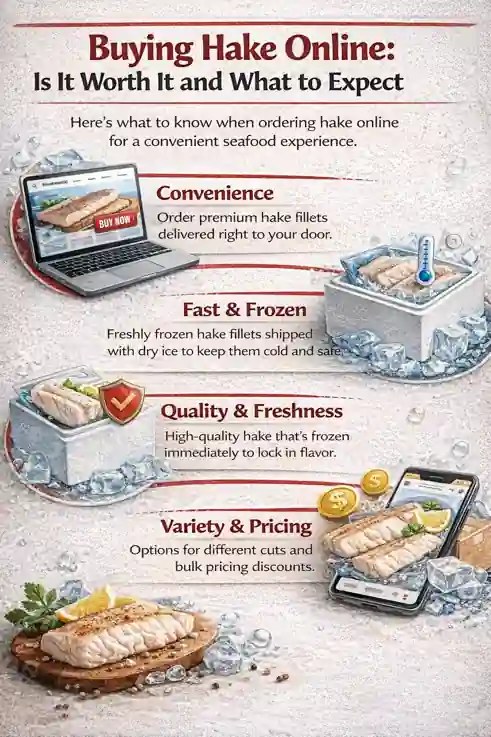
For chefs and experienced buyers, buying hake online is worth it only when the seller controls freshness from catch to delivery. High-quality online hake is typically blast-frozen or packed under strict cold-chain conditions within hours of harvest—often preserving texture and flavor better than “fresh” fish that’s already spent days in transit to retail counters.
However, not all online seafood sellers follow the same standards. The difference between exceptional hake and disappointing hake usually comes down to harvest timing, handling methods, and temperature control, not price or branding.
What to Expect When Ordering Hake Online
When sourced correctly, online hake should arrive firm, moist, and neutral in aroma—not watery, mushy, or fishy. Fillets should be evenly cut with intact flesh, while whole hake should show clear eyes and tight skin if shipped fresh. Packaging matters: vacuum sealing, insulated containers, and ice packs or dry ice are non-negotiable for quality preservation.
Buyers should also expect transparency. Reputable sellers clearly disclose species type, catch location, freezing method, and delivery timing—details chefs rely on when ordering seafood remotely.
Fresh vs Frozen: What Chefs Actually Prefer
Despite common assumptions, many chefs prefer professionally frozen hake ordered online over “fresh” fish of unknown age. Flash-freezing at peak freshness locks in flavor and structure, while improperly handled fresh hake degrades quickly. The key is controlled freezing—not long-term storage or repeated thaw cycles—an approach that fits naturally within a simplified brigade system focused on consistency, efficiency, and predictable kitchen outcomes.
Common Mistakes to Avoid When Buying Hake Online
The most common issues come from vague sourcing claims, unclear shipping windows, and sellers that don’t specialize in seafood logistics. If freshness guarantees, handling methods, or delivery timelines aren’t clearly stated, quality is often inconsistent.
Bottom Line: When Online Hake Makes Sense
Buying hake online makes sense when you choose suppliers that operate with chef-level sourcing standards and provide clear handling transparency. When those conditions are met, online hake can match—and sometimes exceed—what’s available locally.
“From a chef’s standpoint, the quality of hake isn’t determined by whether it’s bought online or in person—it’s determined by how quickly it’s handled after harvest and how tightly the cold chain is controlled. We’ve worked with hake that was ordered online, flash-frozen at peak freshness, and performed better in the kitchen than so-called ‘fresh’ fish that had already spent days in transit, even when compared with skate fish. When sourcing is transparent and handling is done right, online hake can be every bit as reliable as what professionals use.”
Essential Resources
Below are the trusted reference points chefs and experienced buyers use when evaluating hake — whether for sourcing, menu planning, nutrition insights, or sustainability decisions. Bookmark these and come back whenever you need reliable, professional data.
1. NOAA Fisheries – White Hake Species Profile
Chef-level fishery intelligence on Atlantic hake
Official government stock, range, and management information for white hake — the kind of baseline data chefs and buyers rely on to understand availability and fishery health.
https://www.fisheries.noaa.gov/species/white-hake
2. NOAA Fisheries – Pacific Whiting (Pacific Hake) Profile
Detailed catch and stock data for the most commonly used hake
Pacific hake (often marketed as whiting) is one of the most commercially consistent hake sources; this profile helps pros gauge seasonal consistency and supply expectations.
https://www.fisheries.noaa.gov/species/pacific-whiting
3. Seafood Watch – Hake Sustainability Ratings
Sustainability guidance that matters in menu decisions
Monterey Bay Aquarium’s ratings help you choose responsibly caught hake — a key consideration in today’s kitchens and ingredient sourcing.
https://www.seafoodwatch.org/recommendation/hake
4. Maine Sea Grant – Hake Seafood Guide
Practical handling and culinary context from a seafood expert source
This land-grant program’s guide connects harvest to plate — covering texture, seasonal availability, and everyday handling tips.
https://seagrant.umaine.edu/maine-seafood-guide/hake/
5. WebMD – Hake Nutrition & Health Profile
Clinical nutrition breakdown for health-minded menus
Medically informed macro and micronutrient data to support menu positioning and customer nutritional questions.
https://www.webmd.com/diet/health-benefits-hake
6. Biology Insights – Hake Species & Habitat
Scientific context for species differences and ecological insight
Covers hake species classification, habitat, and nutritional properties that help buyers compare varieties and understand their origins.
https://biologyinsights.com/thehake-com-all-about-hake-species-habitat-and-nutrition/
Supporting Statistics
1. Most Americans Still Fall Short on Seafood Intake
Fewer than 25% of U.S. adults eat seafood twice per week.
Only 7.7% of children meet the same benchmark.
In real sourcing terms, this gap is driven by access, confidence, and freshness concerns—not lack of interest.
Source: https://www.cdc.gov/nchs/products/databriefs/db538.htm
2. Federal Nutrition Guidelines Reinforce Seafood’s Role
The FDA recommends at least 8 ounces of seafood per week for adults.
Lean white fish like hake is commonly used by chefs to meet this target without overpowering dishes.
Consistent quality matters more than purchase channels.
Source: https://www.fda.gov/food/consumers/advice-about-eating-fish
3. FDA Monitoring Confirms Hake as a Low-Mercury Choice
Mean mercury level for hake: 0.079 ppm.
Based on decades of FDA commercial seafood testing.
Supports hake’s use as a staple fish for regular consumption.
Source: https://www.fda.gov/food/environmental-contaminants-food/mercury-levels-commercial-fish-and-shellfish-1990-2012
4. Most Seafood in the U.S. Travels Long Distances
Americans consumed 20.5 pounds of seafood per person in 2021.
Roughly 80% of seafood consumed in the U.S. is imported.
In practice, this makes cold-chain control and handling the real quality differentiators—not proximity.
Source: https://www.ers.usda.gov/data-products/charts-of-note/chart-detail/?chartId=108936
Taken together, these statistics show why mild, low-mercury fish like hake fit so naturally into everyday diets—and why its consistent quality and predictable supply make it especially useful when building a reliable recipe costing template for regular, health-focused seafood meals.
Final Thought & Opinion
After working with hake across multiple sourcing channels, one thing consistently holds true: quality is defined by handling, not where the fish is purchased. In real-world kitchens, well-managed online hake often outperforms “fresh” fish that has already lost valuable time in transit or retail storage.
What Experience Shows
Professionally frozen hake can retain better texture and moisture than poorly handled fresh fish.
Transparency around catch timing, freezing method, and delivery matters more than marketing labels.
Controlled cold chains protect flavor and consistency.
Why Online Hake Can Make Sense
Hake has a low mercury profile and fits federal nutrition guidelines.
It’s versatile, forgiving, and well-suited to repeat use.
Most seafood already travels long distances—logistics matter more than location.
Bottom Line
Buying hake online isn’t a shortcut or compromise when sourcing is done right. With clear standards and proper handling, it’s often the more controlled and reliable option. Confidence comes from transparency—and when that’s present, hake delivers exactly what experienced buyers expect.
FAQ on Hake Fish
Q: Is hake a good everyday fish?
A: Yes. Hake has a mild flavor, lean protein profile, and low mercury levels, which is why it’s used regularly in professional kitchens for repeat service.
Q: Is frozen hake lower quality than fresh?
A: Not when it’s handled correctly. From sourcing experience, flash-frozen hake often cooks better than “fresh” fish that has already aged in transit. Quality depends on handling, not labels.
Q: How do you tell if hake is high quality?
A: High-quality hake feels firm, smells clean and neutral, and releases very little water during cooking. Soft texture or excess moisture usually indicates handling issues.
Q: Are there different types of hake?
A: Yes. Common varieties in the U.S. include Atlantic hake and Pacific hake, often sold as whiting. They are similar in flavor but vary in size, sourcing regions, and consistency.
Q: Is hake a sustainable seafood option?
A: It can be. Sustainability depends on the specific fishery and management practices, which is why experienced buyers reference NOAA Fisheries and Seafood Watch when sourcing.