This guide explains how chefs document recipes quickly by relying on proven formats instead of starting from scratch. You’ll learn how to capture recipes efficiently, maintain consistency, and build a reusable recipe system that saves time every time you cook or write.
TL;DR Quick Answers
recipe template
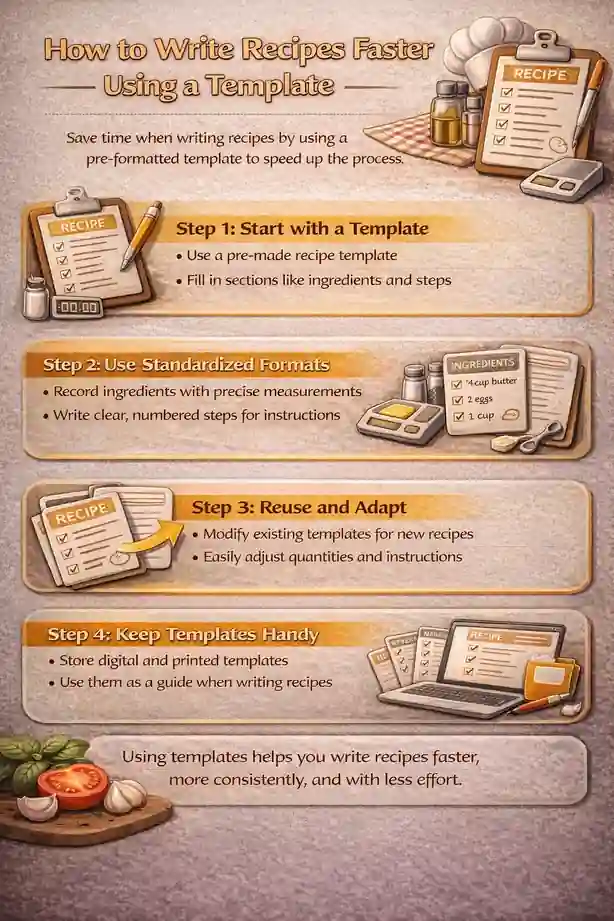
A recipe template is a fixed structure that chefs use to write recipes faster and more consistently.
It standardizes ingredient order, step flow, measurements, and yield, so each new recipe is written by filling in known fields instead of starting from a blank page.
Top Takeaways
Structure speeds writing.
Templates remove repeat decisions.Templates create consistency.
Same format. Every recipe.Chefs use systems.
Fast documentation. Fewer errors.Accuracy improves.
Steps and measurements stay aligned.Speed scales.
Lock the structure. Write faster.
Why Writing Recipes Takes Longer Than It Should
Most recipe writing is slow because the same decisions are made repeatedly—formatting, step order, measurements, and terminology. In professional kitchens, this problem is solved with templates. Once the structure is set, writing a new recipe becomes a matter of filling in variables, not rebuilding the document.
Using a template removes friction and keeps recipes consistent from the first draft.
How Recipe Templates Speed Up the Writing Process
A recipe template provides a fixed framework that includes:
Ingredient order and format
Standard step sequencing
Measurement conventions
Yield and portion fields
With these decisions already made, recipe writing becomes a transcription process rather than a creative rewrite. Chefs use this approach to document recipes quickly while maintaining clarity across an entire menu or recipe collection.
What to Include in a Fast-Write Recipe Template
Effective templates focus on structure, not detail. At minimum, they include:
A standardized ingredient layout
Reusable step prompts (prep, cook, finish)
Notes for variations or substitutions
Yield and scaling information
This keeps writing efficient while allowing flexibility for different dishes.
When Templates Make the Biggest Difference
Templates are especially effective when:
Writing multiple similar recipes
Documenting recipes during service or testing
Building a personal or professional recipe library
In real kitchen use, this approach cuts documentation time significantly because you’re no longer deciding how to write—only what changes.
“In a working kitchen, no one has time to rewrite recipes from scratch. Templates are how chefs document fast without losing consistency—once the structure is set, writing a new recipe becomes filling in the details, not reinventing the process, which is essential for effective kitchen management.”
Essential Resources
These are the tools and guides that chefs and serious recipe developers return to when they’re building structured, reusable recipe systems — not just pretty layouts, but formats that work in real kitchens.
Minnesota Department of Education – Standardized Recipe Template
https://education.mn.gov/mdeprod/idcplg?IdcService=GET_FILE&Rendition=primary&RevisionSelectionMethod=latestReleased&dDocName=057472
An official standardized format used in food service programs to control portions, yields, and documentation — perfect for seeing how professional kitchens document recipes consistently.
Maine DOE – CACFP Standardized Recipe Template
https://www.maine.gov/doe/sites/maine.gov.doe/files/inline-files/Child%20Nutrition%20-%20Standardized%20Recipe%20Template%20for%20CACFP%20-%206.20.24.docx
A government-aligned template example from a large institutional program, showing how recipes are written for accuracy and compliance — excellent practice for templates you’ll use repeatedly.
101 Planners – Editable Recipe Templates
https://www.101planners.com/recipe-template/
Easy-to-customize layouts in PDF, Word, or Google Docs that let you capture structure quickly. Useful when you want a simple base to build faster recipes without reinventing the format each time.
Gdoc.io – Google Docs Recipe Templates
https://gdoc.io/recipe-templates/
Browser-friendly templates with ingredient and instruction sections pre-built — perfect for digital recipe collections you want to reuse and share.
Nutrition.gov – Printable Materials & Meal Planning Tools
https://www.nutrition.gov/topics/basic-nutrition/printable-materials-and-handouts
Government-sourced resources that support structured meal planning and organized documentation, so you can build templates that align with healthy cooking practices.
Florida Dept. of Agriculture – Steps to Standardize a Recipe Guide
https://www.fdacs.gov/content/download/91920/file/StepstoStandardizeRecipe.pdf
A hands-on instructional guide detailing how to turn informal recipes into standardized documents — a key skill when you start writing recipes faster and more consistently.
These resources reflect how the kitchen brigade system depends on clear documentation, defined order of operations, and standardized formats, showing how recipe templates function as written systems that keep execution consistent, roles clear, and results reliable across any kitchen.
Supporting Statistics
~40 minutes per day spent on food prep and cleanup (BLS).
In practice, much of this is rereading and rewriting recipes. Templates remove repeat decisions and speed up writing and prep.
Source: https://www.bls.gov/news.release/atus.t01.htm30–40% of the U.S. food supply goes uneaten (EPA).
Unclear yields and inconsistent documentation drive overbuying. Templates lock in portions and batch size upfront.
Source: https://www.epa.gov/sustainable-management-food/united-states-2030-food-loss-and-waste-reduction-goal~133 billion pounds of food wasted annually, ~$161B in value (USDA).
Rewriting recipes introduces variation and errors. Templates standardize yield, scaling, and sequence.
Source: https://www.usda.gov/about-food/food-safety/food-loss-and-waste/food-waste-faqs73.9 million tons of surplus food in 2023 (31% of supply) (ReFED).
Professional kitchens rely on systems. Templates enable fast documentation with control.
Source: https://refed.org/articles/food-waste-remains-stubbornly-high-despite-signs-of-progress-according-to-new-refed-report/
These statistics show how time loss, food waste, and inconsistency stem from unstructured recipes, while reusable templates reduce waste and inefficiency in ways that support sustainable fаrmіng by improving portion control, minimizing surplus, and making better use of ingredients from start to finish.
Final Thought & Opinion
Slow recipe writing is usually a structure problem.
In hands-on kitchen use, speed improves once the format stays consistent.Templates turn writing into a repeatable task.
Steps, order, and measurements are predefined, so documenting a recipe is faster and more accurate.Chefs rely on systems, not blank pages.
Templates allow recipes to be captured quickly without sacrificing consistency.The real benefit is control.
Fewer errors, better repeatability, and scalable recipe documentation.
Bottom line: Lock in the structure, and recipe writing stops slowing you down.
FAQ on Recipe Template
Q: What is a recipe template?
A:
A fixed recipe framework.
Standardizes order, steps, measurements, and yield.
Reflects how chefs document recipes.
Q: Why do templates speed up recipe writing?
A:
Remove repeat decisions.
Structure stays the same.
Only ingredients and variations change.
Q: Who benefits from recipe templates?
A:
Home cooks.
Food bloggers.
Meal planners and kitchens.
Q: Do templates work for complex recipes?
A:
Yes.
Especially useful for timing and precision.
Reduces errors in technical steps.
Q: Do templates limit creativity?
A:
No.
Structure handles mechanics.
Creativity stays focused on flavor.