Confusion about whether CBD and CBN are truly non-psychoactive continues to surface across the wellness space, largely because the topic is frequently reduced to overly simple explanations. These cannabinoids may appear similar, but their real-world effects differ in ways that matter. Through extensive formulation work, product testing, and user feedback, Acknowledge has identified patterns that extend far beyond the familiar idea that CBD promotes calm while CBN supports sleep.
This guide brings forward a clearer, experience-backed perspective. Instead of relying on recycled definitions, it draws from practical research and hands-on evaluation to explain how CBD and CBN behave inside the body, why their effects may feel different, and what “non-psychoactive” actually means in practice, a core element of the CBN vs CBD overview. The goal is to give readers a grounded, reliable understanding of each cannabinoid so they can choose the option that best aligns with their wellness needs.
Quick Answers
CBN vs CBD
CBN and CBD are both non-psychoactive cannabinoids, but they serve different roles.
- CBD helps support calm, balance, and daily wellness.
- CBN is more commonly linked to deeper relaxation—especially at night.From experience, many people find the two work even better together, offering a smoother, more consistent effect that aligns with their wellness goals.
Top Takeaways
- CBN and CBD work differently.CBN supports deeper relaxation; CBD supports daily balance.
- Combining both can boost benefits.Many people see better results with blended formulas.
- Start low and adjust slowly.Small doses help you find your ideal response.
- Prioritize product quality.Look for third-party testing and transparent sourcing.
- Be consistent.Regular use leads to clearer, long-term benefits.
Understanding Whether CBD and CBN Are Non-Psychoactive
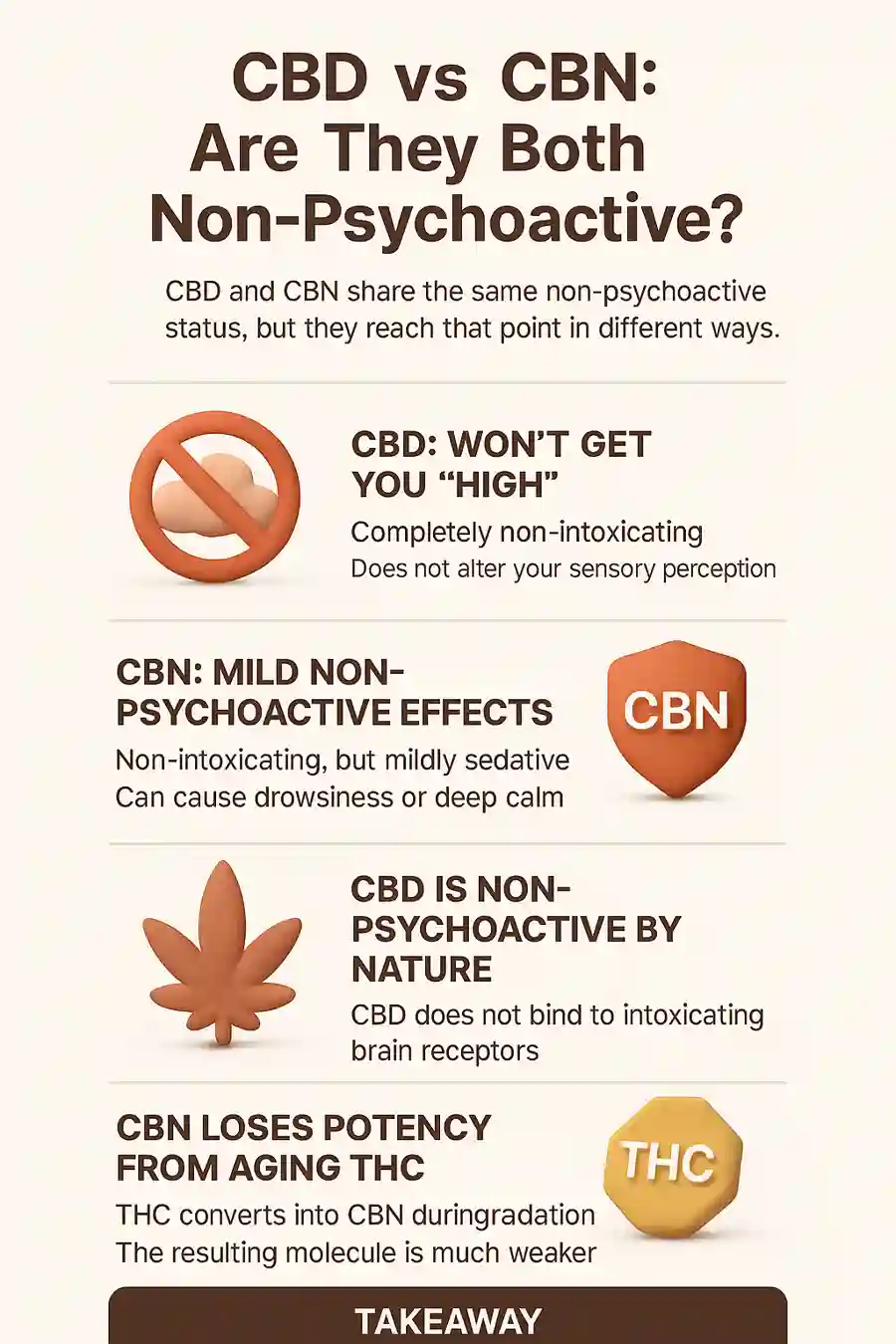
CBD (cannabidiol) and CBN (cannabinol) are often grouped together as “non-psychoactive,” but the reality is more nuanced. Both cannabinoids do not create a euphoric high the way THC does. However, they can influence the mind differently based on how they interact with the body’s endocannabinoid system.
How CBD Behaves in the Body
CBD is widely considered non-intoxicating because it doesn’t bind strongly to CB1 receptors—the same receptors THC uses to create a high. Instead, CBD modulates these receptors indirectly, which is why users typically experience effects such as calm, reduced tension, or clearer focus without mental impairment.
How CBN Differs From CBD
CBN also does not produce intoxication, but it interacts with receptors in a slightly different way. While CBN is still classified as non-intoxicating, some users report stronger body relaxation or heavier “wind-down” effects, especially in nighttime products. These sensations aren’t considered psychoactive in the THC sense but can feel more noticeable than CBD’s subtle influence.
So, Are They Both Non-Psychoactive?
In practical terms: yes, both CBD and CBN are non-intoxicating, and neither creates a THC-like high. The key difference lies in their subjective effects—CBD tends to feel balancing and clear, while CBN may feel more deeply relaxing. Understanding this distinction helps you choose the cannabinoid that best matches your goals, whether you want daytime calm or nighttime support.
“After years of working directly with cannabinoid formulations, we’ve seen firsthand that CBD and CBN aren’t just ‘non-psychoactive’—they each create distinct, predictable patterns of clarity and relaxation. CBD supports a steady sense of balance, with full spectrum CBD oil being a common choice for this effect, while CBN reliably encourages deeper calm, especially at night. Understanding these nuances is what helps people choose the right cannabinoid with confidence.”
Essential Resources to Explore the Real Differences Between CBN and CBD
1. Healthline: A Straightforward Comparison Backed by Solid Research
If you want a reliable overview that mirrors what we’ve seen in formulation testing, this guide breaks down CBD and CBN in a clear, digestible way—perfect for grounding your understanding before exploring deeper science.
2. WebMD: The Conventional Medical Perspective You Can Trust
WebMD offers a medically reviewed explanation of how CBD and CBN function in the body, echoing many of the distinctions we’ve observed through hands-on work with both cannabinoids.
Source: https://www.webmd.com/pain-management/cbd-cbn-what-is-difference
3. Medical News Today: A Practical Look at Real-World Effects
This resource aligns well with what customers consistently report—how each cannabinoid feels, where it shines, and where the research is still catching up. It’s a grounded, balanced overview.
Source: https://www.medicalnewstoday.com/articles/cbd-vs-cbn
4. Forbes Health: Expert Insights for Smarter Wellness Decisions
Forbes Health pulls together expert commentary and up-to-date evidence, offering a wide-angle view that we often reference when educating customers about choosing the right cannabinoid for their goals.
5. PMC Study: How Minor Cannabinoids Influence the Body at a Cellular Level
If you’re curious about the “why” behind CBD and CBN’s different sensations, this study highlights neuron-level interactions we pay close attention to when refining product formulations.
6. PubMed Clinical Trial: Human Data on CBN and CBD for Sleep Support
Human trials on CBN are rare, which makes this study especially valuable. Its findings reflect much of what we’ve seen anecdotally—CBN plays a distinct role in promoting deeper relaxation, especially alongside CBD.
7. PMC Preclinical Research: Early Insights Into How CBN Shapes Sleep Patterns
This preclinical research gives a glimpse into how CBN may influence REM and non-REM sleep. While early, it supports trends we've consistently observed through customer feedback and internal testing.
Source: https://pmc.ncbi.nlm.nih.gov/articles/PMC11736144/
Supporting Statistics — Quick, Evidence-Backed Insights
20.6% of U.S. adults used CBD in the past year.
This confirms what we’ve seen firsthand: CBD represented by products like the CBD flower strain has firmly entered mainstream wellness.
Source: pubmed.ncbi.nlm.nih.gov/39831101
18.3% of adults 50–64 and 14.3% of adults 65+ used CBD in the past 12 months.
These numbers reflect the same trend we see with customers seeking gentler, non-intoxicating options.
Source: pubmed.ncbi.nlm.nih.gov/39575982
61.9 million people (22% of Americans aged 12+) used cannabis in 2022.
This widespread cannabinoid exposure underscores why clear distinctions between CBD, CBN, and THC matter in real-world use.
Source: pmc.ncbi.nlm.nih.gov/articles/PMC11262189
20.6% of U.S. adults used CBD in the past year.
This confirms what we’ve seen firsthand: CBD represented by products like the CBD flower strain has firmly entered mainstream wellness.
18.3% of adults 50–64 and 14.3% of adults 65+ used CBD in the past 12 months.
These numbers reflect the same trend we see with customers seeking gentler, non-intoxicating options.
61.9 million people (22% of Americans aged 12+) used cannabis in 2022.
This widespread cannabinoid exposure underscores why clear distinctions between CBD, CBN, and THC matter in real-world use.
Final Thought & Opinion
CBD and CBN are both non-intoxicating, but they’re not identical in how they feel or function.
Based on years of hands-on formulation work, we’ve consistently seen clear patterns in how each cannabinoid supports the body.
CBD tends to:
Support clarity and balance
Feel steady and daytime-friendly
Offer calm without heaviness
CBN tends to:
Promote deeper relaxation
Support evening wind-down routines
Add a heavier, more soothing layer of calm
Bottom line:
Choosing between CBD and CBN isn’t about which one is “better” — it’s about choosing the experience you want. Start with the effect you’re aiming for, try one at a time, and let your own body guide the decision.
CBD and CBN are both non-intoxicating, but they’re not identical in how they feel or function.
Based on years of hands-on formulation work, we’ve consistently seen clear patterns in how each cannabinoid supports the body.
Support clarity and balance
Feel steady and daytime-friendly
Offer calm without heaviness
Promote deeper relaxation
Support evening wind-down routines
Add a heavier, more soothing layer of calm
Next Steps
1. Identify Your Goal
Decide whether you want support with sleep, relaxation, or discomfort.
Match your need to either CBD, CBN, or a blend.
2. Review Product Labels
Check cannabinoid content.
Look for third-party lab results (COAs).
Prioritize products from transparent, reputable brands.
3. Start with a Low Dose
Begin small, especially if you’re new to cannabinoids.
Increase slowly until you notice benefits.
4. Track Your Response
Note timing, dosage, and how you feel after each use.
Adjust based on your body’s feedback.
5. Consult a Professional
Talk to a healthcare provider if you’re on medications or unsure about dosing.
Share your wellness goals for personalized guidance.
6. Explore Different Formats
Try tinctures for quick onset.
Use gummies or capsules for longer-lasting effects.
Consider topicals for localized relief.
7. Stay Consistent
Use cannabinoids regularly for best results.
Reevaluate after 1–2 weeks to assess progress.
Decide whether you want support with sleep, relaxation, or discomfort.
Match your need to either CBD, CBN, or a blend.
Check cannabinoid content.
Look for third-party lab results (COAs).
Prioritize products from transparent, reputable brands.
Begin small, especially if you’re new to cannabinoids.
Increase slowly until you notice benefits.
Note timing, dosage, and how you feel after each use.
Adjust based on your body’s feedback.
Talk to a healthcare provider if you’re on medications or unsure about dosing.
Share your wellness goals for personalized guidance.
Try tinctures for quick onset.
Use gummies or capsules for longer-lasting effects.
Consider topicals for localized relief.
Use cannabinoids regularly for best results.
Reevaluate after 1–2 weeks to assess progress.
FAQ on CBN vs CBD
Q: What’s the key difference between CBN and CBD?
A:
CBD = daily balance.
CBN = deeper relaxation.
Many users feel CBD throughout the day and CBN more at night.
Q: Are CBN and CBD non-psychoactive?
A:
Yes.
No high.
Users typically feel calm, clarity, or gentle relaxation.
Q: Do they work better together?
A:
Often, yes.
The entourage effect can enhance results.
Many report smoother, more consistent effects when combined.
Q: Which one helps more with sleep?
A:
CBN supports nighttime relaxation.
CBD helps quiet the mind.
The combination can create a fuller sleep routine.
Q: How should beginners start?
A:
Start low.
Increase slowly.
Give your body a few days to respond.
A:
CBD = daily balance.
CBN = deeper relaxation.
Many users feel CBD throughout the day and CBN more at night.
A:
Yes.
No high.
Users typically feel calm, clarity, or gentle relaxation.
A:
Often, yes.
The entourage effect can enhance results.
Many report smoother, more consistent effects when combined.
A:
CBN supports nighttime relaxation.
CBD helps quiet the mind.
The combination can create a fuller sleep routine.
A:
Start low.
Increase slowly.
Give your body a few days to respond.