Canning recipes are engineered to exacting standards. The spice measurements written into a tested recipe aren't suggestions — they're part of a formula that determines flavor consistency across every jar in the batch. After years of watching the same problem surface in professional kitchens and home canning operations alike, we've traced most seasoning inconsistency back to the same root cause: volume measurements applied without accounting for density differences between spices. A teaspoon of whole mustard seed and a teaspoon of ground mustard occupy the same space but behave entirely differently by weight. Scale that gap across a twenty-jar batch and the flavor drift becomes impossible to ignore.
This spice yield conversion chart was built for canning applications specifically — covering the whole-to-ground and volume-to-weight conversions most relevant to pickle brines, fruit preserves, and custom spice blends. If your canned batches don't taste consistent from one season to the next, the data on this page is where we'd start looking.
TL;DR Quick Answers
Spice Yield Conversion Chart
A spice yield conversion chart translates volume measurements into actual gram weights — accounting for the density differences that make a universal conversion factor unreliable across a full spice shelf.
Why it matters:
Common canning spices vary by a factor of 2.5 in weight per teaspoon — lightest to heaviest
A single conversion factor applied across all spices is wrong for a significant portion of a typical canning pantry
Volume measurements lock in at the moment of processing — there is no correction window once a jar is sealed
Density categories to know:
Dense spices (cloves, mustard seed, black pepper): more weight per teaspoon, less volume per gram
Medium spices (coriander, cinnamon, turmeric): mid-range yield
Light spices (dill seed, celery seed): less weight per teaspoon, more volume per gram
Who needs it:
Home canners scaling tested recipes across multi-jar batches
Anyone substituting ground spices for whole — or whole for ground
Canners working from recipes inherited without documented gram weights
Bottom line: Volume measurements tell you how much space a spice occupies. A yield conversion chart tells you how much spice you actually have. In canning, only one of those numbers determines what ends up in the jar.
Top Takeaways
Flavor consistency starts at the measuring spoon — not the canner. Processing method matters. Spice measurement precision determines whether a batch reproduces season to season.
A 2.5x density spread means universal conversion is wrong for a significant portion of your canning pantry. Highest-variation spices:
Mustard seed
Cloves
Dill seed
Coriander
Whole-to-ground substitutions change more than form. Without yield data, they change flavor — and that error doesn't surface until the jar is opened weeks later, after the correction window is gone.
Storage variables shift what a teaspoon actually delivers. Four factors that affect yield every season:
Spice age
Humidity and compaction
Supplier differences
Grind coarseness
Consistent batches come from better information, not better technique. One fix: convert your highest-impact canning spices to gram weights once, and record those weights alongside your volume measurements.
Why Spice Measurements Matter More in Canning Than in Everyday Cooking
In everyday cooking, an imprecise spice measurement is a recoverable error. You taste, you adjust, you move on. Canning doesn't offer that correction window. Once a jar is sealed and processed, the flavor is locked in — and if your spice measurements drift from the recipe's intent, you won't know until you open that jar weeks or months later. By then, the batch is done and the season may be over.
Tested canning recipes are developed with specific spice quantities for reasons beyond flavor. Whole spices in a brine behave differently than ground spices in terms of how they release flavor compounds during processing and storage. Ground spices integrate faster and more completely, which means substituting ground for whole — or miscalculating the conversion between the two — doesn't just change how a recipe tastes out of the jar. It changes how the flavor develops over the shelf life of the product. That's a variable worth measuring accurately from the start.
The Whole-to-Ground Conversion Problem in Canning
Most tested canning recipes call for whole spices — whole mustard seed, whole cloves, whole allspice berries, whole dill seed. There are good reasons for that. Whole spices are easier to remove from a brine before jarring, they release flavor more gradually during processing, and they're less likely to cloud the liquid in the jar.
But home canners substitute ground for whole regularly — because they have ground on hand, because whole spices aren't available locally, or because they're working from a modified recipe. When that substitution happens without accurate yield data, the results vary widely.
The conversion isn't a simple one-to-one swap. Whole spices lose volume when ground because the grinding process breaks down the physical structure that created air pockets in the whole form. A measured tablespoon of whole spices becomes a smaller volume of ground — but how much smaller depends entirely on the spice. Key whole-to-ground conversions for common canning spices:
Whole allspice berries to ground allspice: 1 teaspoon whole yields approximately 1 teaspoon ground
Whole cloves to ground cloves: 1 teaspoon whole yields approximately ¾ teaspoon ground
Whole mustard seed to ground mustard: 1 teaspoon whole yields approximately 1½ teaspoons ground
Whole coriander seed to ground coriander: 1 teaspoon whole yields approximately 1¼ teaspoons ground
Whole black peppercorns to ground pepper: 1 teaspoon whole yields approximately 1½ teaspoons ground
Using a flat one-to-one conversion across these spices produces different results with every substitution. Using yield-specific data produces results you can replicate.
Scaling Spice Amounts Across Canning Batch Sizes
Scaling a canning recipe from a small test batch to a full production run is where spice measurement errors compound most visibly. A quarter-teaspoon variance in a four-jar batch is barely perceptible. That same proportional error scaled to a twenty-jar batch becomes a full teaspoon — enough to push a spice blend noticeably out of balance.
The standard approach to recipe scaling — multiply everything by the same conversion factor — works reliably for most canning ingredients. It works less reliably for spices, particularly strong spices like ground cloves, cayenne, and ground ginger, which don't always scale linearly without flavor consequences. Our general guidance when scaling spice-heavy canning recipes:
Convert all spice measurements to grams before scaling — volume measurements accumulate error faster than weight measurements when multiplied
Scale to the gram weight first, then convert back to a practical kitchen volume measurement using density-specific yield data
For strong spices — cloves, cayenne, ginger — scale to 75–80% of the calculated amount first, taste the brine or mixture before jarring, and adjust from there
Document your final gram weights alongside volume measurements so the recipe is reproducible at any batch size without recalculating from scratch
Volume-to-Weight Conversions for Common Canning Spices
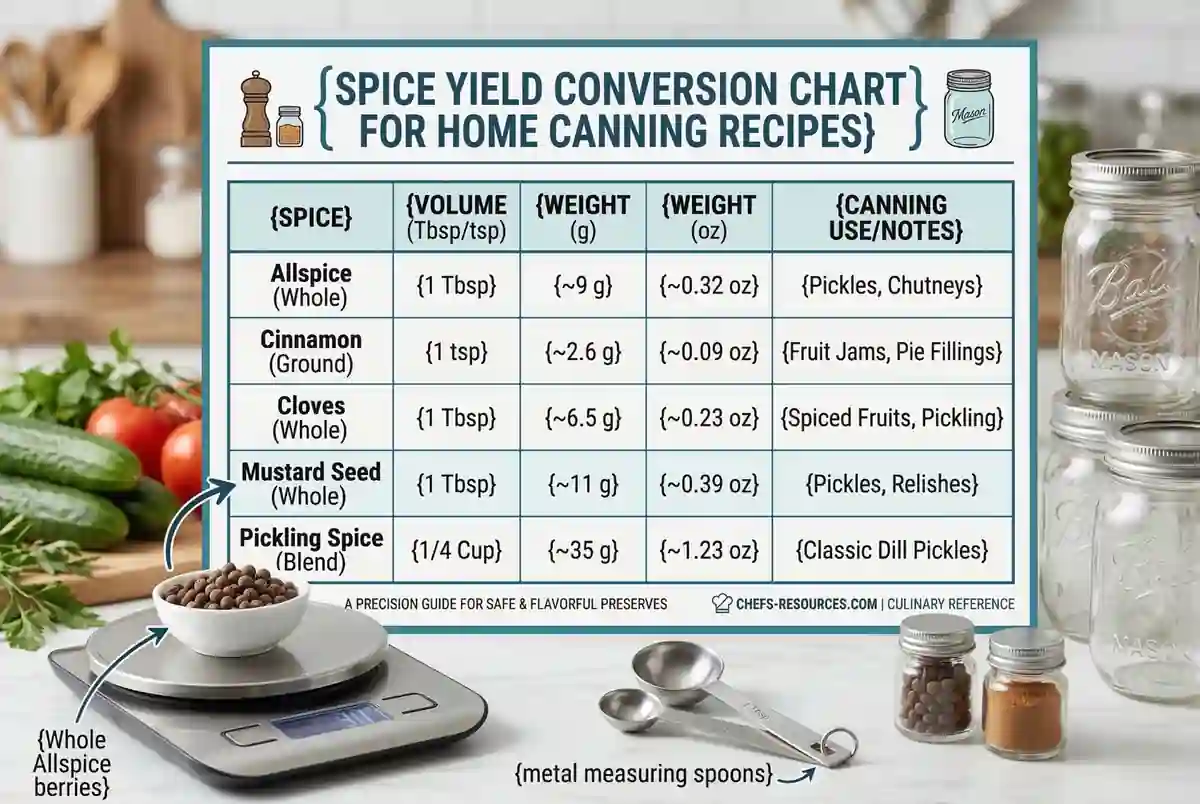
The spices most frequently used in home canning span a wide density range — which means a universal conversion factor will be inaccurate for most of them. Reference these density-specific yield figures when converting volume measurements in canning recipes to weight for scaling or costing purposes:
Mustard seed: 6.40 oz per cup / 2.50 tsp per oz
Celery seed: 3.81 oz per cup / 4.20 tsp per oz
Dill seed: 3.69 oz per cup / 4.33 tsp per oz
Whole cloves: 3.00 oz per cup / 5.33 tsp per oz
Allspice, ground: 3.37 oz per cup / 4.75 tsp per oz
Cinnamon: 4.09 oz per cup / 3.92 tsp per oz
Cayenne: 3.56 oz per cup / 4.50 tsp per oz
Turmeric: 4.00 oz per cup / 4.00 tsp per oz
Ginger, ground: 3.25 oz per cup / 4.92 tsp per oz
Black peppercorns: 4.57 oz per cup / 3.50 tsp per oz
Storage and Measurement Variables That Affect Canning Spice Yields
Density isn't static. The same spice measured in late summer from a freshly opened container will yield slightly differently than the same spice measured in early spring from a container that's been open on a shelf for months. For everyday cooking that variability is negligible. For canning — where you're trying to replicate a batch exactly from one season to the next — it's worth accounting for.
The variables that affect spice yield accuracy most significantly in a home canning context:
Age and moisture loss. Older ground spices lose volatile oils and moisture, becoming lighter per teaspoon over time. A spice that measured 0.50 tsp/g when fresh may measure closer to 0.55 tsp/g after six months of storage.
Container exposure. Spices stored in frequently opened containers settle and compact differently than spices in sealed containers. Compacted spices yield more weight per teaspoon — meaning you're using more spice than the recipe intends without realizing it.
Humidity. In humid conditions, spices absorb moisture and weigh more per measured volume. If you're canning in a humid environment, your volume measurements may be delivering more spice by weight than the same measurement would in a dry climate.
Supplier and grind differences. The same spice from two different suppliers can yield measurably differently if grind coarseness varies. Coarser grinds are lighter per gram. Finer grinds pack more densely. If you switch suppliers mid-season, verify your yield data still holds before scaling a full batch.
Building a Reliable Spice Reference for Your Canning Season
The most practical thing a home canner can do with spice yield data is document it once and use it every season. The process is straightforward:
Weigh your most-used canning spices at the start of each canning season using a scale accurate to 0.1 grams
Record the gram weight for one teaspoon and one tablespoon of each spice from your current containers
Note the supplier, the grind description, and the date measured
Build those weights into your recipe documentation alongside volume measurements
When you open a new container mid-season, spot-check the weight against your reference before scaling a full batch
That reference — built from your actual spices, your actual containers, your actual kitchen — will be more accurate than any published chart, including ours. Published yield data, including what we provide here, is based on averages across commercial spice varieties. Your personal reference, organized within a simple recipe template, is based on exactly what goes into your jars. For a home canner trying to replicate a batch that worked perfectly last August, that level of specificity is what makes the difference.
"Home canners ask us why their pickle brine tastes different from one season to the next when they follow the exact same recipe. Nine times out of ten the answer isn't the cucumbers, the vinegar, or the processing time — it's the spices. A jar of whole mustard seed that's been open since last August measures differently by weight than a fresh container, and a ground clove substitution made without yield data can push a brine noticeably out of balance across a twenty-jar batch. We built this conversion data for canning applications specifically because the correction window that exists in everyday cooking doesn't exist once a lid is sealed. You get one shot at the measurement. Density-specific yield data is what makes that shot repeatable from one canning season to the next."
Essential Resources
Chefs Resources Dry Spice Yield Chart — The Only Conversion Reference Built Around Density, Not Assumption
We built this chart because universal conversion factors fail half the spices on a typical canning shelf. It organizes 40+ spices by density category so you're working from measured data, not estimates, when you translate recipe volumes to gram weights. URL: https://www.chefs-resources.com/culinary-conversions-calculators-and-capacities/dry-spice-yields/
National Center for Home Food Preservation — Where Tested Canning Recipes Come From
Every spice quantity in a trusted canning recipe traces back to USDA-funded research. Before you convert or substitute anything, know what the tested baseline actually is — this is where to find it. URL: https://nchfp.uga.edu/
USDA Complete Guide to Home Canning — The Document Behind Every Safe Procedure
This is the reference that established the spice quantities home canners have been working from for decades. If you're converting measurements in a tested recipe, this is what you're converting from. URL: https://nchfp.uga.edu/resources/category/usda-guide
USDA FoodData Central — Federal-Grade Weight Data When You Need to Verify
We cross-check against this database when a spice isn't on our yield chart or when a figure doesn't look right. Hundreds of spices. Verified gram weights per common measure. The most reliable secondary source available. URL: https://fdc.nal.usda.gov/
Allied Kenco Spice Conversions Chart — A Practical Ounce-to-Volume Reference Worth Keeping
Not a substitute for density-specific data, but a useful cross-check when you're working from ounce-based canning formulas and need a quick volume equivalent. Keep it alongside the yield chart, not instead of it. URL: https://www.alliedkenco.com/pdf/Spice%20Conversions.pdf
Shamrock Foods Dry Spice Conversions — Production-Scale Data That Applies to Multi-Batch Canning Runs
Built for foodservice accuracy, which makes it relevant when you're scaling beyond a single canning session. Small measurement errors compound across jars — this reference was designed for environments where that margin matters. URL: https://www.shamrockfoodservice.com/wp-content/uploads/2018/05/DrySpiceConversions.pdf
American Weigh Scales GEMINI-20 — Conversion Data Is Only as Good as the Scale Behind It
We've seen accurate charts produce inconsistent results because the scale rounding to the nearest gram introduced more error than the chart removed. For 1–4 gram spice quantities common in canning recipes, 0.1g precision isn't optional — it's what makes the data work. URL: https://awscales.com/gemini-20-precision-milligram-scale/
These essential resources help canners and cooks verify spice densities, convert volume to weight accurately, and maintain consistency across batches. The same careful measurement, resource awareness, and repeatable process reflect the mindset behind sustainable fаrmіng, where precise inputs and disciplined systems are what keep production reliable and long-term outcomes stable.
Supporting Statistics
Stat 1 — Fewer Than Half of Home Canners Use Recommended Processing Methods for Vegetables
The conversation about canning accuracy almost always starts at the canner. It rarely starts at the measuring spoon. That's the gap we've been trying to close.
Key findings from the National Center for Home Food Preservation national survey:
44.2% of home canners used a recommended pressure-based method for vegetables (national sample)
32.8% used a recommended method in the parallel state survey — even lower
43.5% identified untrained friends or relatives as their primary instruction source
The percentage consulting USDA and Extension publications had declined since 1975
We've seen this pattern in the questions that reach us. Home canners learn from people who learned from people. Somewhere in that chain, the precision gets lost. Spice measurements are usually the first casualty.
Source: National Center for Home Food Preservation, University of Georgia — Current Home Canning Practices in the U.S. URL: https://nchfp.uga.edu/how/can_06/prep_foods.html
Stat 2 — Home-Canned Vegetables Are the Most Common Source of Foodborne Botulism Outbreaks in the United States
We've spent years explaining that canning is less forgiving than everyday cooking. The CDC data makes that case more directly than we ever could.
What the record shows:
Home-canned vegetables are the most common cause of foodborne botulism outbreaks in the continental U.S. (CDC)
A June 2024 outbreak in Fresno County, California resulted in 8 botulism cases tied to home-canned nopales
6 patients were admitted to intensive care
2 required invasive mechanical ventilation
Investigation found: no formal canning training, no published guidance followed
What we draw from cases like this isn't just the safety argument — it's the precision argument. The person in that kitchen wasn't cutting corners. They were working from incomplete information. That's the same condition that produces spice measurement drift across a twenty-jar batch. The stakes differ. The root cause doesn't.
Sources: CDC — Home-Canned Foods and Botulism Prevention URL: https://www.cdc.gov/botulism/prevention/home-canned-foods.html
CDC MMWR — Foodborne Botulism Outbreak After Consumption of Home-Canned Cactus, Fresno County, California, June 2024 URL: https://www.cdc.gov/mmwr/volumes/74/wr/mm7424a1.htm
Stat 3 — Up to 57% of Home Canners Use Methods Deemed Unsafe by USDA Standards
The number that stopped us when we first encountered it: 57%.
What the research found:
Up to 57% of home canners use processing methods outside USDA safety standards
Source: 2011 Journal of Food Protection study tracking three botulism outbreaks in Ohio and Washington, 2008–2009
All three outbreaks linked to improperly home-canned vegetables
NCHFP survey data confirms the pattern — a significant share of canners still use open kettle methods for vegetables despite decades of guidance against it
Our read on why this persists:
Most canning mistakes aren't reckless — they're uninformed
People inherit methods that were never accurate to begin with
The assumption gets passed down; the measurement never does
Spice yield errors aren't dangerous the way botulism is. But the dynamic is identical. Someone is working from an assumption instead of a measurement, and the jar is sealed before the error surfaces.
Source: USDA National Agricultural Library — How Did We Can? Canning Timeline URL: https://www.nal.usda.gov/exhibits/ipd/canning/timeline-table
These supporting statistics show how gaps in measurement knowledge and inherited practices continue to affect home canning outcomes. Bringing the same level of structure found in a kitchen brigade system—where tasks, procedures, and measurements are clearly organized—helps create consistency in preparation, improves accuracy in spice measurement, and reduces the kind of errors that accumulate across batches.
Final Thought & Opinion
We've measured a lot of spices over the years. The conclusion we keep arriving at is the same: the measuring spoon is where canning recipes either hold or drift — and most home canners never think about it that way.
The safety conversation in home canning centers on processing. Pressure versus water bath. Temperature. Time. Seal integrity. Those things matter. But the flavor conversation — whether a batch tastes right, whether it's consistent season to season — starts at the measuring spoon, long before the canner comes to pressure.
What the data and our own experience keep confirming:
A 2.5x density spread exists across common canning spices — the lightest and heaviest measure that differently by weight per teaspoon
Whole-to-ground substitutions change yield — without conversion data, they change flavor in ways that don't surface until the jar is opened weeks later
Older spices weigh less per teaspoon than fresh — same volume, less material, thinner flavor
Humidity, compaction, supplier differences, and grind coarseness all introduce variables a universal conversion factor cannot account for
What gets missed in the broader canning precision conversation: the people most likely to get spice measurements wrong aren't careless. They're working from inherited methods and volume-only recipes that were never built to absorb real spice variability. They follow the recipe exactly and still get a different result. They blame the cucumbers. They adjust the processing time. The measuring spoon never comes under scrutiny.
Our opinion after watching this pattern repeat across years of questions from home canners:
Density-specific yield data isn't a professional kitchen tool that found its way into home use. It's a measurement foundation home canning has always needed and largely gone without. Volume measurements applied to materials with variable density will always produce variable results, a reality that kitchen management must account for. That's physics, not technique.
Three things that would change the outcome for most home canners:
Convert highest-impact spices to gram weights — mustard seed, cloves, dill seed, and coriander are where yield variation is largest
Record gram weights alongside volume measurements — so the conversion happens once, not every season
Weigh new containers before scaling a full batch — supplier and grind differences are real, and a mid-season check takes less than two minutes
The canners who produce consistent results year over year aren't more skilled than anyone else. They're working from better information. That's what this page is here to provide.
FAQ on Spice Yield Conversion Chart for Home Canning Recipes
Q: What is a spice yield conversion chart and why does it matter for home canning?
A: A spice yield conversion chart maps volume measurements to actual weight — accounting for density differences a standard conversion factor ignores. Why it matters in canning specifically:
In everyday cooking, you can taste and adjust
In a sealed jar, the measurement made before processing is the one you're opening weeks later
A density-specific chart is the only reliable bridge between what a tested recipe calls for and what's actually going into the jar
We built our chart for canning applications because the correction window that exists in cooking doesn't exist once a lid is sealed.
Q: Why can't I use a standard teaspoon-to-gram conversion for canning spices?
A: A single conversion factor applied across all spices is wrong for a significant portion of a typical canning pantry. What the numbers show:
The lightest and heaviest common canning spices differ by a factor of 2.5 in weight per teaspoon
That spread is large enough to shift brine balance and flavor profile across a multi-jar batch
In everyday cooking that error gets absorbed. In a sealed jar it gets locked in.
We've measured enough spices to say that with confidence. This isn't a rounding issue — it's a density problem that a universal factor cannot solve.
Q: How do I use a spice yield conversion chart when substituting ground spices for whole in a canning recipe?
A: Check yield data for both forms before substituting. Grinding changes density. Density determines how much material a teaspoon delivers. Substitutions that cause the most trouble in canning:
Whole cloves → ground: 1 tsp whole ≈ ¾ tsp ground
Whole mustard seed → ground: 1 tsp whole ≈ 1½ tsp ground
Whole black peppercorns → ground: 1 tsp whole ≈ 1½ tsp ground
Whole coriander → ground: 1 tsp whole ≈ 1¼ tsp ground
Always convert to gram weights before scaling across a full batch. Volume accumulates error faster than weight when multiplied across multiple jars.
Q: Does spice age affect yield enough to matter in canning recipes?
A: Yes — and it's the variable home canners underestimate most. What happens as spices age:
Spices lose moisture over time
An older spice is physically lighter per teaspoon than a fresh container of the same spice
The recipe hasn't changed. The measurement hasn't changed. The result has.
Highest-risk spices for age-related yield shift:
Cloves
Mustard seed
Dill seed
Fix: Weigh most-used canning spices at the start of each season. Don't assume last year's measurements still hold.
Q: How do I build spice yield data into my canning recipes so I don't have to recalculate every season?
A: Convert once. Document the result. That's the system that makes year-over-year consistency achievable without recalculating every session.
Weigh most-used canning spices at season start using a 0.1g precision scale
Record gram weight per tsp and tbsp from current containers
Note supplier, grind description, and date measured
Add gram weights to recipe documentation alongside original volume calls
Spot-check new containers mid-season before scaling a full batch
The canners who ask us the fewest repeat questions about batch inconsistency are the ones who did this work once and built it into their recipes. The conversion becomes invisible. The consistency doesn't.