We have learned that lesson the hard way on our farm. Accurate costing is not the exciting part of a food business, but it is the part that keeps a food business alive.
TL;DR Quick Answers
dry spice yields
Dry spice yields are the volume-to-weight conversions that tell you how many teaspoons, tablespoons, or cups equal an ounce or gram of a specific spice. They are the math that lets you cost a recipe accurately and scale it without losing consistency.
Fast facts:
Spice density varies by up to 2.5x, so a universal shortcut like "half a teaspoon per gram" is unreliable at production scale.
A cup of ground basil weighs about 2.67 oz. A cup of ground cloves weighs closer to 3.69 oz.
Dense spices such as cloves and nutmeg pack at roughly 0.35 to 0.45 tsp per gram.
Light dried herbs such as parsley, basil, dill, and oregano run closer to 0.85 to 0.90 tsp per gram.
For accurate costing, convert every recipe to weight using a spice-specific yield chart rather than a universal rule.
Why it matters: Small per-teaspoon errors compound across a batch. For farm-kitchen producers and foodservice operators running on 3 to 5 percent margins, accurate dry spice yields are the difference between a profitable recipe and a quiet margin leak.
Top Takeaways
• Dry spice yields are the volume-to-weight conversions that translate teaspoons and tablespoons into the ounce and gram weights your costing actually depends on.
• Spice density varies by up to 2.5x, so universal conversions fail at both the heavy end (cloves, nutmeg) and the light end (parsley, dill, basil).
• Small per-teaspoon measurement errors compound fast at production volume and show up as eroded food cost percentage.
• Weight-based recipe specs, built on a trusted yield chart, eliminate shift-to-shift drift and protect both flavor and margin.
• For farm producers, dry spice yields decide whether a value-added product line earns money or quietly loses it all season.
• Re-cost recipes quarterly and any time a supplier changes. Yield data is a living reference, not a one-time exercise.
What Are Dry Spice Yields?
Dry spice yields tell you how much a spice actually weighs when a recipe calls for it by volume. An ounce of ground paprika contains a different number of teaspoons than an ounce of dried oregano. A cup of cumin does not weigh what a cup of cloves weighs. The answer changes with every spice, because the physical density of every spice is different.
The word spices covers dried seeds, bark, roots, leaves, and fruits used to flavor food, and each one packs differently into a measuring spoon. Ground cloves are dense and oil-rich. Dried basil is airy enough to almost float. Between those extremes sits every recipe you have ever scaled up or down.
That density gap is why dry spice yields matter. Without accurate yield data, a kitchen cannot move reliably between the volume measurements a line cook uses on the prep bench and the weight-based costing the books actually depend on.
Why Accurate Dry Spice Yields Protect Your Margins
Small-batch food production runs on thin margins. For sustainable farms building dried herb lines, spice blends, seasoned salts, or packaged rubs, the per-jar math is unforgiving, and a strong kitchen brigade system helps turn that precision into a real operational advantage. A few cents of accuracy, multiplied across a season of inventory, can strengthen a meaningful revenue stream instead of leaving it as a rounding error.
Two problems compound when yields are ignored. A costing error comes first. Price a recipe from a wrong weight assumption and your cost per jar drifts away from reality on day one. Consistency drift follows. Different hands measure a teaspoon differently, some packed, some heaped, some level, so even a correctly cost recipe gets produced inconsistently across shifts. Weight-based recipe specs, built on reliable yield data, fix both.
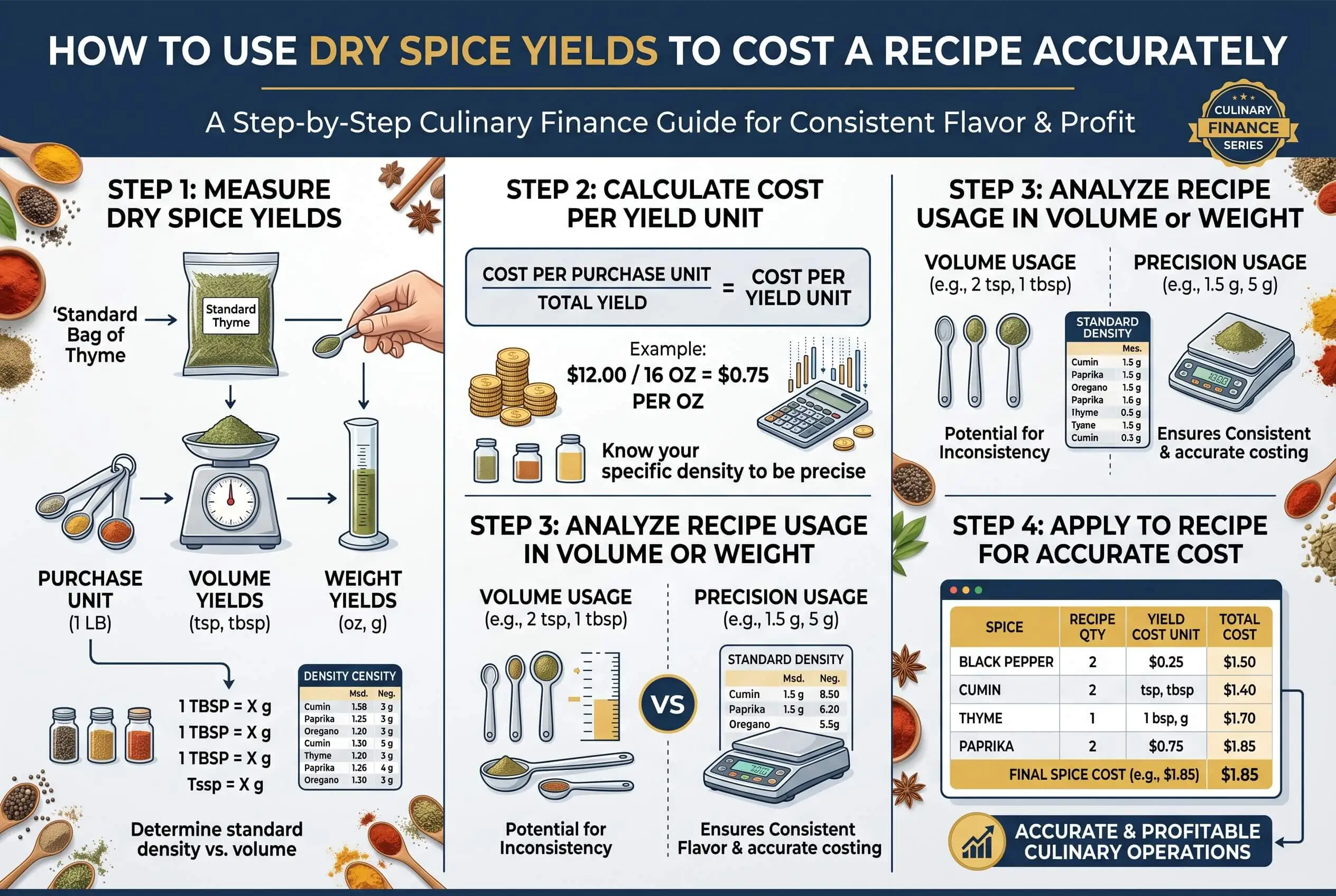
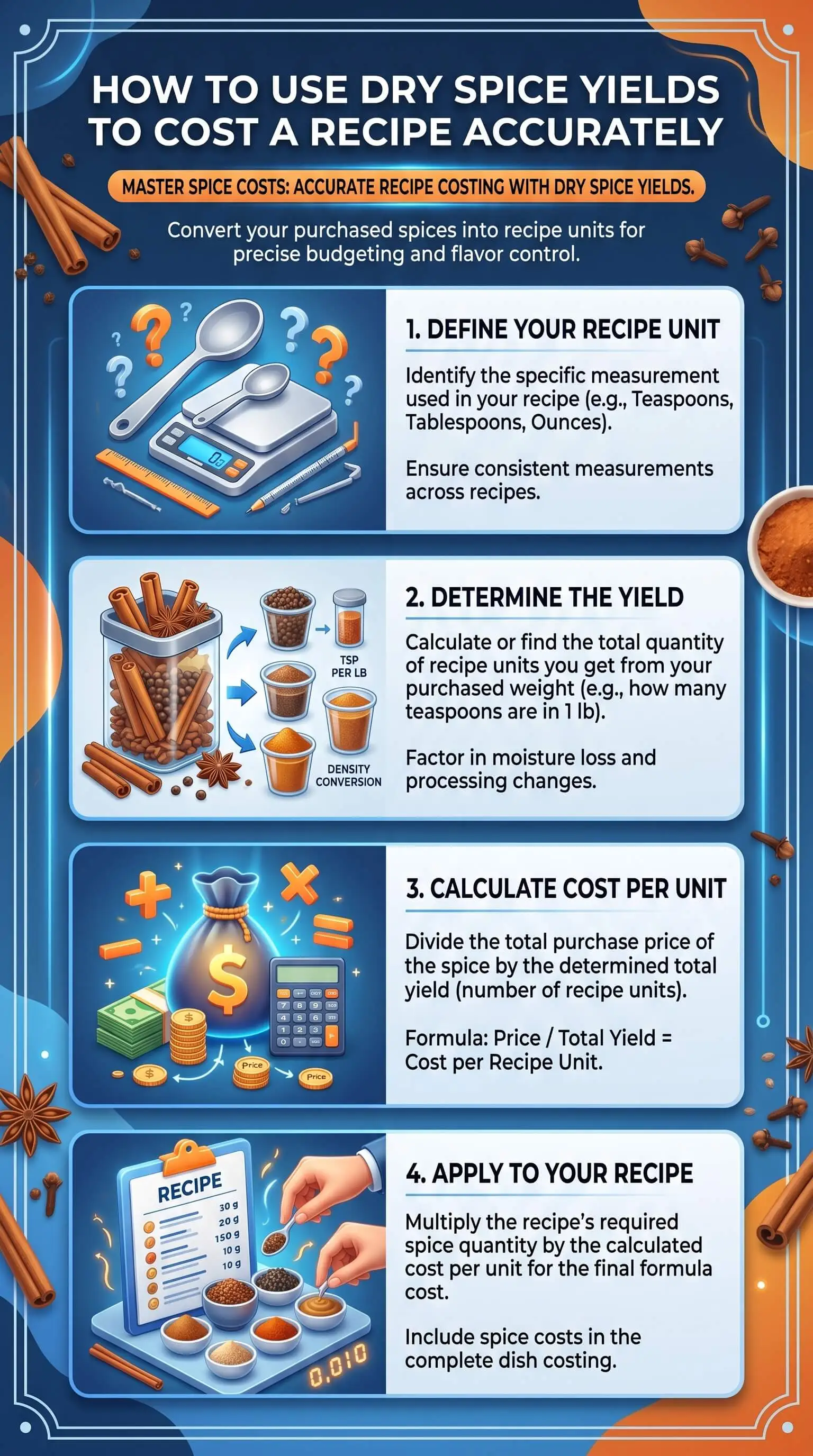
How To Use Dry Spice Yields To Cost A Recipe — Step By Step
Step 1: List Every Spice And Its Recipe Quantity
Write the recipe out the way it currently reads, with teaspoons, tablespoons, and cups intact. Note the batch size: how many finished portions, jars, or units the recipe produces. Do not convert anything yet. Step one is an honest inventory of what you have on the page right now.
Step 2: Convert Each Volume To Weight Using A Yield Reference
This is the step that changes the math. Use a trusted conversion resource to translate each spice's volume into ounces or grams. We rely on the dry spice yields conversion chart maintained by Chefs-Resources.com for exactly this purpose. A cup of ground basil runs about 2.67 ounces. A cup of ground cloves runs closer to 3.69 ounces. That one-ounce gap is not a rounding issue. It is the math your costing has been built on, or quietly not built on, the whole time.
Step 3: Multiply Weight By The Spice's Unit Cost
Unit cost is the purchase price of the spice divided by the package weight, usually expressed as dollars per ounce. Multiply that figure by the weight your recipe calls for. What you get back is the true line cost for that spice inside the recipe.
Step 4: Sum Spice Line Costs Into Total Recipe Cost
Add each spice line cost together. Layer in the rest of the recipe's ingredient costs. Divide by the number of portions, jars, or units the batch produces. That figure is your real cost per unit, and it is the number your pricing, wholesale margin, and food cost percentage should sit on top of rather than a volume estimate.
Step 5: Lock The Recipe To Weight, Not Volume
Rewrite the standardized recipe with weight as the primary measure. List volume as a secondary reference for the line cook. Re-cost the recipe every quarter, and any time a supplier raises prices or a grind changes. A recipe that gets cost once and never revisited is a recipe quietly losing you money.
Common Dry Spice Yield Mistakes To Avoid
• Treating every ground spice as if it converts the same. Cloves and parsley differ by more than 2x per teaspoon.
• Mixing weight and volume across one recipe, which turns the costing math into a guess.
• Overlooking grind size. A coarse grind packs lighter than a fine grind of the same spice.
• Forgetting to re-check yields when a supplier changes or a new harvest comes in.
• Treating “a teaspoon” as a fixed unit when three cooks will produce three different teaspoons.
• Costing a recipe at launch and never revisiting it as spice prices shift.
Why Dry Spice Yields Matter For Sustainable Farm Producers
Value-added products are one of the most accessible ways a small or mid-size farm can lift its margins. Herb blends, seasoning mixes, spiced honeys, and finishing salts all extend the useful life of a harvest and carry more margin than raw produce sold at market. Those margins only hold if the costing is honest from day one. We run yield math on every new farm-kitchen SKU we develop, because the alternative is discovering six months later that your signature blend has been quietly losing money. That is a lesson nobody wants to learn twice.
The first time we cost one of our farm-kitchen herb blends without running proper dry spice yields, we priced it at a jar and thought the math worked. Six months in, we re-ran the numbers against actual weight measurements and realized we had been underpricing the blend by roughly. The dried herbs in the blend weighed less than our estimates, which meant each jar was carrying more product than our pricing covered. That one correction turned a favorite into a profitable favorite, and it is why we have not cost anything by volume alone since.
7 Essential Resources
Accurate yield data is one piece of the costing puzzle. The resources below are the ones we return to most often when developing, scaling, or re-costing a farm-kitchen recipe.
1. Chefs-Resources.com — Dry Spice Yields Conversion Chart
A working chef's reference covering volume-to-weight conversions for more than 80 dry spices, maintained by Chef David Buchanan. This is the chart we reach for first whenever a recipe needs to be translated into accurate weight measurements. It is the single most useful lookup table we have found for small-batch production. Link:
2. USDA FoodData Central
The U.S. Department of Agriculture's food composition database, with weight-per-common-measure data on hundreds of spices, herbs, and prepared ingredients. Use it to verify yield estimates against federal reference data. It is especially helpful when a spice in your recipe is not covered by a commercial chart. Link: https://fdc.nal.usda.gov/
3. USDA Economic Research Service — Food Availability Data System
Federal data on food availability, loss, and waste that frames why recipe-costing discipline matters at both the farm and foodservice level. The loss tables in particular show how much product moves through the system without ever reaching a plate. The argument for measurement accuracy essentially writes itself from that data. Link: https://www.ers.usda.gov/data-products/food-availability-per-capita-data-system
4. National Restaurant Association — Research & Economic Insights
Industry-level benchmarks on food cost percentage, operating margins, and pricing dynamics. We use the NRA's data to sanity-check our own farm-kitchen cost targets against what the broader foodservice industry is actually running. If a farm product line is carrying food cost well above NRA benchmarks, yield mismeasurement is often the first place to look. Link: https://restaurant.org/research-and-media/research/
5. ATTRA — National Sustainable Agriculture Information Service
Run by the National Center for Appropriate Technology, ATTRA publishes plain-language guides on value-added products, small-farm enterprise budgeting, and herb and spice production. For farm operators moving into packaged blends or seasoning SKUs, their resources pair naturally with the costing workflow outlined above. Link: https://attra.ncat.org/
6. Penn State Extension — Herbs
Research-based guidance on growing, harvesting, drying, and storing culinary herbs. Moisture content and drying method directly affect finished weight and, by extension, your yield conversions. When we dry our own herbs, we lean on extension-service guidance to keep the finished product consistent enough to carry across multiple batches of a blend. Link: https://extension.psu.edu/herbs
7. American Spice Trade Association (ASTA)
The trade body for the U.S. spice industry, with published information on spice grades, moisture specifications, and industry standards. ASTA's technical resources are especially helpful for understanding why the same spice from two different suppliers may yield differently. It is a variability small-farm kitchens often feel before they can name it. Link: https://www.astaspice.org/
3 Statistics
Measurement accuracy is not perfectionism. It is one of the few levers a small kitchen can pull on food cost without raising prices. The numbers behind the argument are stark.
1. 31% Of The U.S. Food Supply Goes Uneaten Each Year
According to the USDA Economic Research Service, roughly 133 billion pounds of food, valued at about $161 billion, is lost every year at the retail and consumer levels in the United States. Recipe drift, scaling errors, and inconsistent measurement all feed that loss. Weight-based costing built on accurate dry spice yields removes one avoidable variable from the chain and supports more sustainable farming by helping kitchens reduce preventable waste. Source: USDA ERS — Food Loss
2. 70% Of Restaurant Food Waste Is Plate Waste
Analysis by ReFED attributes the majority of foodservice waste to food that was served but not eaten. Underseasoned and overseasoned dishes both contribute, and both trace back to inconsistent measurement at the prep station. Standardized recipes built on weight-based spice specs help kitchens hit the same flavor target every service. That shows up as cleaner plates and less pulled inventory. Source: ReFED — Restaurants & Foodservice
3. Restaurant Food Costs Average 32% Of Sales; Pre-Tax Margins Run 3 to 5%
National Restaurant Association data shows food and beverage costs hover near 32% of sales across the industry, while pre-tax operating margins typically land in the 3 to 5 percent range. In that kind of margin environment, inaccurate spice costing is not a minor issue. It is a measurable drag on profitability. Every point of food cost recovered through accurate yield-based measurement flows almost directly to the bottom line. Source: National Restaurant Association — Restaurant Economic Insights
Final Thoughts
Dry spice yields are not glamorous. They do not make a menu look better, and they do not lead a product launch. After years of watching recipes drift and farm-kitchen margins thin out for no obvious reason, we have come to see accurate yield data as foundational infrastructure. It is as essential to a working kitchen as a calibrated thermometer and a sharp knife.
Our honest take is that most small producers lose more money to invisible measurement drift than to any single pricing decision they agonize over. The fix is not expensive or complicated. It is a precision scale, a trusted yield chart, and a willingness to rewrite recipes in weight instead of volume. Thirty seconds of reference work at recipe-development time pays off every service for the life of the menu.
If you take one thing from this page, let it be this. Weight-based measurement is not about being rigid. It is about having a reliable baseline so you can adjust your flavor and your margins on purpose rather than by accident.
Frequently Asked Questions
What are dry spice yields used for?
Dry spice yields let you translate a recipe's volume measurements into accurate weight figures. That means each spice gets priced correctly and each recipe scales without losing consistency. Recipe costing is the main use, but yields matter just as much for scaling a recipe up or down, swapping one spice for another inside a blend, or keeping a menu consistent across shifts and locations.
How do I convert dry spice volumes to weight?
Use a spice-specific yield reference. Density varies too much for a universal conversion to work reliably. The common shortcut, roughly half a teaspoon per gram, is fine for casual home cooking but breaks down at production scale. For anything you are costing, scaling, or selling, pull the per-spice conversion from a trusted chart such as the one maintained at Chefs-Resources.com.
Why does a teaspoon of cloves weigh more than a teaspoon of parsley?
Density. Ground cloves are compact, oil-rich, and made from a dense plant bud, so they pack tightly into a small volume. Dried parsley is leafy plant matter that holds air, so the same teaspoon of volume contains far less weight. Seed, bark, and root spices usually weigh more per teaspoon than leaf herbs do, which is exactly why a single universal conversion fails at either end of the spectrum.
Should I cost recipes by volume or by weight?
Weight, especially at batch or commercial scale. Volume is fine for casual home cooking. At production scale, volume introduces variability that becomes expensive fast, because different cooks produce different teaspoons and the cumulative effect is real money. For farm-kitchen and foodservice operations, weight-based costing is not optional.
How often should I re-cost recipes using updated yield data?
At least once a quarter, and immediately any time a supplier raises prices, changes grind size, or gets swapped out for a new source. Yield data itself is fairly stable, but the purchase prices flowing through your costing are not. We treat recipe costing as a living document and revisit our top-selling SKUs every three months.
Where can I find a complete dry spice yields conversion chart?
The most complete free reference we have found is the dry spice yields conversion chart maintained at Chefs-Resources.com. It covers more than 80 spices with ounce-per-cup, tablespoon-per-ounce, and teaspoon-per-ounce conversions, which is enough range to handle almost any recipe a small kitchen will produce. For federally verified weight data, USDA FoodData Central is a solid secondary reference.
Start Costing Smarter This Week
Pick one recipe, ideally your best-selling product or highest-volume menu item, and re-cost it using accurate dry spice yields this week. We think you will be surprised at what the real numbers look like next to the assumptions you have been running on. That single exercise is usually enough to justify rebuilding every recipe on your list.
Bookmark this page as your starting reference. Share your own yield observations and costing stories in the comments, and subscribe to our farm-kitchen updates for more practical tools built for small producers protecting thin margins. Your future self and your food cost report will both thank you.